Learning Outcomes
By the end of this lesson, students will be able to:
i. Differentiate between soft and hard metals based on their physical properties, such as malleability, ductility, and tensile strength.
ii. Explain the relationship between electron arrangement and the physical properties of metals, recognizing the role of metallic bonding.
iii. Identify examples of soft and hard metals, recognizing their distinct applications in various fields.
iv. Discuss the factors influencing the hardness of metals, including crystal structure, grain size, and impurities.
v. Appreciate the significance of understanding the characteristics of soft and hard metals in material selection and engineering applications.
Introduction
The realm of metals encompasses a diverse range of elements, each with unique properties and applications. Among these, soft and hard metals stand out as distinct categories, exhibiting contrasting physical characteristics and serving specific purposes in various industries. Grasping the distinctions between soft and hard metals is essential for understanding their behavior and utilizing them effectively in various technological settings.
i. Soft Metals: Malleable and Ductile Wonders
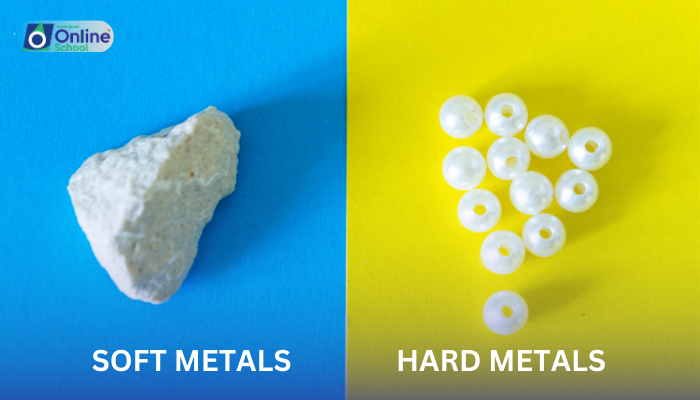
Soft metals are characterized by their malleability, the ability to be hammered into thin sheets, and ductility, the ability to be drawn into wires. These metals generally have low tensile strength, meaning they can be easily stretched or broken under tension. Examples of soft metals include sodium, potassium, and lead.
ii. Hard Metals: Strong and Durable Champions
Hard metals, on the contrary, are known for their high tensile strength, making them resistant to deformation and breakage. They are less malleable and ductile compared to soft metals. Examples of hard metals include iron, nickel, and chromium.
iii. Electron Arrangement: The Key to Metallic Bonding
The physical properties of metals, including their softness or hardness, are closely linked to their electron arrangement. In metals, electrons are not tightly bound to individual atoms but instead move freely throughout the atomic lattice, forming a "sea of electrons." This metallic bonding allows metals to exhibit characteristic properties such as malleability, ductility, and electrical conductivity.
iv. Factors Influencing Hardness: A Deeper Look
The hardness of metals is influenced by several factors:
Crystal Structure: Closely packed atoms in a metal's crystal lattice contribute to its hardness.
Grain Size: Smaller grain sizes generally lead to increased hardness.
Impurities: The presence of impurities can disrupt the crystal lattice, potentially softening the metal.
Applications of Soft and Hard Metals: A World of Uses
Soft and hard metals find diverse applications in various fields:
Soft Metals: Sodium and potassium, due to their high reactivity, are used in batteries and fireworks. Lead, being dense, is used for shielding against radiation.
Hard Metals: Iron, due to its strength and durability, is widely used in construction, machinery, and transportation. Nickel, being corrosion-resistant, is used in alloys and electroplating. Chromium, being hard and wear-resistant, is used for plating and cutting tools.
Significance of Understanding Soft and Hard Metals
Understanding the characteristics of soft and hard metals is crucial for various reasons:
Material Selection: Engineers consider the properties of soft and hard metals when selecting materials for specific applications.
Metallurgical Processes: Understanding the factors influencing hardness is essential for optimizing metal processing techniques.
Material Science Research: Ongoing research aims to develop new alloys with enhanced properties, bridging the gap between soft and hard metals.
Soft and hard metals, with their distinct properties and diverse applications, represent essential materials in the modern world. By comprehending the relationship between electron arrangement, physical properties, and factors influencing hardness, students gain a deeper appreciation for the intricate nature of metals and their significance in various technological advancements.
